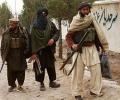
The much anticipated peace talks between the Taliban and the United States might not happen as well, a US official said, as the Special US envoy for Afghanistan and Pakistan left Qatar without any talks with the Afghan insurgent group.
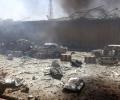
'A couple of more such happenings in the coming weeks can push Kabul into total anarchy, and a Syria-like conflict may ensue,' warns Ambassador M K Bhadrakumar.

Congress leaders were in for a rude shock on Monday when the media sidelined their much-touted Jawaharlal Nehru birth anniversary event, and instead turned its full attention to Prime Minister Narendra Modi, who was addressing thousands of supporters in Sydney's Allphones Arena
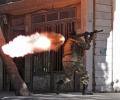
Pakistan-based terror outfit Lashkar-e-Tayiba was responsible for the terror attack at the Indian Consulate in Afghanistan's Herat province last month, the US said on Wednesday.
We should be prepared for a phase of increased tensions in India-Pakistan relationship thanks to the evolving situation in Afghanistan, says Shyam Saran.
"We have from time to time reminded all stakeholders about the red lines that was drawn by the world community and certainly by the participants should not be touched, should not be erased and should not be violated," External Affairs Minister Salman Khurshid told media persons.

Seeking to reassert Jawaharlal Nehru's legacy, Congress President Sonia Gandhi said secularism is a compelling necessity for a country as diverse as India.

Being attended by nearly 40 countries and leading groupings like the European Union, the annual conference of the Heart of Asia -- Istanbul Process is deliberating on various challenges facing Afghanistan, including revival of a peace process in the conflict-ridden country.

The Bharatiya Janata Party has cautioned the United States against any peace talks with the Taliban arguing the terrorist outfit is unlikely to change its behaviour and as reconciliation effort would be a futile exercise.

For the first time, China has come out openly backing Pakistan's Inter-Service Intelligence saying the spy agency could not have been involved in the recent attack on an Indian consulate in Afghanistan.

Much has been said about Friday's attack on the Indian consulate in Heart and the connection it has with the invitation sent out to Pakistan Prime Minister Nawaz Sharif. While a few believe that the two could be connected, officers who have worked in Afghanistan-Pakistan say the issues are completely different. Vicky Nanjappa reports
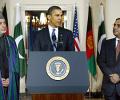
'The real purpose of President Obama writing to President Zardari,' Husain Haqqani tells Rediff.com's Aziz Haniffa, 'was to seek a turnaround on terrorism -- that Pakistan, whatever its grievances, cannot have jihadi groups operating openly on its soil.'

'Obama's decision to end the US military involvement in the Afghan civil war needs to be welcomed as a positive development for regional security and stability. India, too, has a great opportunity opening up here if it plays its cards in sync with the spirit of the times rather than continuing to view the Afghan problem in zero-sum terms,' says Ambassador M K Bhadrakumar.

"The weak don't survive, the strong survive. You make peace, alliances with the strong. You are able to maintain peace by being strong," he said.

How to deal with a country that has made export of terror a reason to make the world notice and fund it? Rediff.com contributor Sanjeev Nayyar offers a few suggestions

A list of all the foreign visits taken up by PM Narendra Modi this year and their outcomes.

Describing India's concerns as legitimate, a top United States official has said that there is no immediate danger of foreign fighters from Afghanistan moving towards the Indian border after 2014, when American troops leave the country.
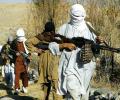
Pakistan National Security Advisor Sartaj Aziz brings to New Delhi a newfound Pakistani confidence, stemming from its leverage in Afghanistan, says Ajai Shukla

'It is important to note that American officials were trying their best to use the Taliban for their oil games till December 1997 when Mullah Ghous was invited to America. State Department officials did not show any interest in capturing or killing Osama bin Laden even at that time.'

India on Tuesday supported Afghanistan's reconciliation process with the Taliban, but warned that it must not undermine the legitimacy of the Afghan government and should be within the internationally accepted "red lines".

After days of speculation, Prime Minister Manmohan Singh confirmed he would meet his Pakistan counterpart Nawaz Sharif in New York, when he is expected to convey concerns over "barbaric" incidents on the LoC and continued terrorism emanating from Pakistan.

As Afghanistan gradually realises that there can be no long-term stability in the country as long as Pakistan is involved, the time has come for India to register its solidarity when it would be most appreciated, says former foreign secretary Shyam Saran.
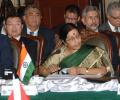
India on Wednesday extended a hand of friendship to Pakistan, saying it was time the two countries display "maturity and self-confidence" to do business with each other.

Afghanistan will never allow its territory to be used for any anti-India activity, Afghan ambassador Shaida Mohammad Abdali said here and dismissed apprehensions that withdrawal of NATO forces may allow the Taliban to make a comeback.

'What needs to be pursued as the operations progress is a degree of reconciliation amongst the other parties, less the more orthodox Al Qaeda affiliates.'

The India-Afghanistan relationship does not have to be a template of each country's relations with Pakistan, and Delhi will do well to leave it to Ghani to redefine the parameters of Afghanistan's security cooperation with India. A zero-sum mindset can only exacerbate regional tensions, says Ambassador M K Bhadrakumar.
'Some Pakistani generals are saying -- a little more so now than before -- that the biggest threat to Pakistan is not external -- not India -- but internal.' 'The proof of that will be their change of policies and that is going to be the challenge,' Rakesh Sood, one of India's most distinguished diplomats, tells Aziz Haniffa/Rediff.com in Washington, DC.

'India alone cannot walk the path of peace. It also has to be Pakistan's journey to make,' says Prime Minister Narendra Modi at the government's geo-political flagship initiative "Raisina Dialogue-II".

'Perhaps the biggest indication was its striking decision in November to delink LeT from its aid certification process.' 'The administration decided that the US, in order to send military aid to Pakistan, would not need to certify that Pakistan is cracking down on LeT.' 'Perhaps the administration was trying to offer a carrot -- in effect, we're backing off on LeT, but in return we expect you (Pakistan) to go after the Haqqanis.' 'Either way, the optics were dreadful for the US given that Hafiz Saeed was released from house arrest a few days after the US move.' 'The US reacted angrily, but eventually it moved on, and refocused on its core concern: The Afghan-focused terror groups.'

'Despite almost $30 billion of funding since 2001, all the US reaps today is unmitigated hostility of a Pakistan emboldened to flaunt its China card.' 'How can the US give credence to any offers from Pakistan, which has trotted out the standard alibi of non-State actors time and again, including dreaded terror outfits being out of State control, Pakistan itself being a victim and so forth?'
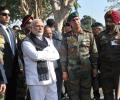
'The attack on the Pathankot base constituted an act of war. Yet Modi's only public comment up until now on that attack has been to blame it on "enemies of humanity".' 'Modi came to power talking tough about Pakistan. But in office, he has pursued a Pakistan policy that has lost both direction and purpose,' argues Brahma Chellaney.
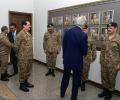
'Both India and Pakistan are now, for the first time in history, very closely allied and connected with the US -- economically and politically.'
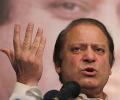
The biggest success of Nawaz Sharif's visit to India is that it will lessen mistrust between the two countries, writes Amir Mateen from Islamabad.

A very delayed and subdued reaction, at a time when the non-aligned world had expected a big country like India to come out in support of rights and justice. It was yet another example of the mealy mouthed approach that has come to define Indian foreign policy, says Seema Mustafa.

'US counter-terrorism policy was encouraging and emboldening the Indians to deal with the problem of Pakistani-supported terrorism once and for all.' 'The US had been trying to browbeat Pakistan into doing what it wants, with very limited success.'
